

Capex Projekte: Mehrwert schaffen statt Ziel verfehlen

Capex entscheidet Innovation und Performance
Investitionen sind notwendig, um die Wettbewerbsfähigkeit Ihrem Unternehmen zu erhalten. Oft ermöglicht Capex, Umsatz zu steigern und Kosten zu senken. Capex ermöglicht auch, die Substanz Ihrem Unternehmen zu behalten und die Sachanlagen sicher und nachhaltig zu betreiben.
Capex setzt Ihre Strategie um und bestimmt, wie gut Sie Ihr Unternehmen für die Zukunft vorbereiten!
Capex-Projekte sind complex und es geht um viel Geld
Nur wenige CAPEX-Projekte werden „on time“ und „on cost“ umgesetzt. Eine Auswertung von Projekten aus den Industrien Bergbau, Öl- und Gasförderung und Infrastruktur ergibt dass 98% der Projekte verzeichnen Kosten- oder Zeitüberschreitungen (Beispiele sind Elbphilharmonie Hamburg, Thyssen-Krupp Stahlwerk in Brasilien u.v.m).
Neben der intrinsische Komplexität eines Capex-Projekt, beobachten wir wiederkehrende Fehler in der Planung, u.a.
- Projektstart basiert auf allzu optimistischen Annahmen, wobei während der gesamten Projektlaufzeit der Projektumfang zunimmt
- Projekte sind zu sehr auf technische Inhalte fokussiert, ohne den monetären Wertbeitrag konsequent in den Mittelpunkt zu stellen
- Komplexität und Capex-Bedarf nehmen zu, da möglichst alle operativen Risiken mit “der Technik” abgedeckt werden sollen
- Marktperspektive für alternative Anlagenlieferanten fehlt
Normalerweise nehmen die Kosten in Capex-Projekten während dessen Lifecycle zu, eine optimale Planungsphase verringert dieses Risiko!
Wertorientierter Capex Design-Prozess „MiniMax“ optimiert Investitionsbedarf
Der MiniMax-Ansatz zeigt einen neuen Weg für die Planung großer CAPEX-Projekte, da er auf cross-funktionale Planung, klare Kommunikation und konsequente Ausrichtung an der Wertschöpfung fokussiert ist
Das Ziel ist klar: Schneller und mit weniger Risiken höchste Profitabilität erreichen
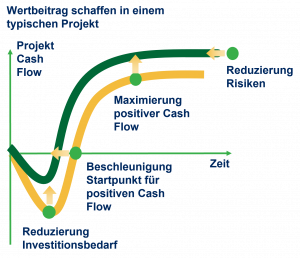
Der MiniMax-Ansatz optimiert die Profitabilität (NPV Net Present Value) einer Investition durch konsequente Ausrichtung an der Wertschöpfung
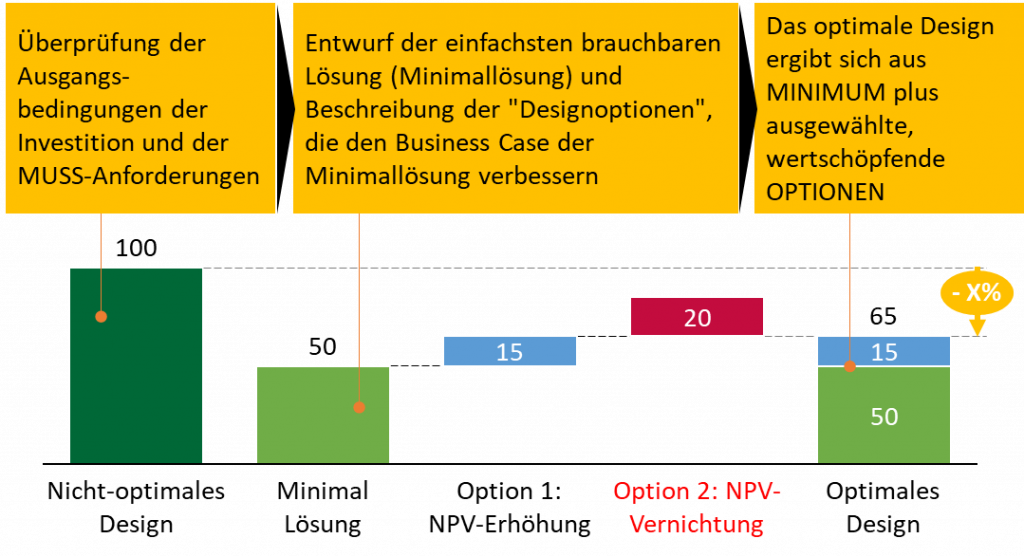
“MiniMax” bietet klare Vorteile
- Hohe Akzeptanz: Ausgangspunkt ist nicht das aktuelle Design, an dem viele Leute hart gearbeitet haben, sondern die Minimallösung, die noch nie entwickelt werden musste
- Modularer Ansatz: Je nach Reife des Projekts und Umfang kann die Optimierung auf höchster Ebene (Makro) oder innerhalb einzelner Wertschöpfungsblöcke (Midi) erfolgen
- Objektive Entscheidungen: Die Bewertung jeder Designoption folgt einem hochstandardisierten Prozess mit einem bewährten Toolkit
- Schnell: Normalerweise können selbst die größten Projekte innerhalb von 2 Monaten überprüft und optimiert werden. Dies ermöglicht die Wiederaufnahme von Projekten, die kurz vor dem Abbruch standen
Ich sehe eine neue Arbeitsdynamik zwischen dem Projektteam und den Managementteam, bei der kreative und brillante Ideen mit positiven Ergebnissen diskutiert werden.
Mit MiniMax vermeiden wir, in einem „emotionalen“ Rahmen zu arbeiten, sondern in einem wertorientierten!
Der Prozess und die Struktur sorgen für Fokus und Klarheit, und damit werden wir in Zukunft mehr Projekte mit weniger Investitionsausgaben durchführen können.
Capex projects: creating value vs. missing targets
Capex determines Innovation and Performance
Investments are necessary to keep your business competitive. Typically, Capex helps to increase Revenues and reduce Costs. Capex also is needed to maintain your physical assets, to have safe and sustainable Operations.
Capex is necessary to implement your strategy and determines how good are you preparing your business for the future!
Capex projects are complex with huge money at stake
Only few Capex projects are completed “on time“ and “on budget“. Independent analysis on Mining, O&G and infrastructure projects show that 98% of projects are completed with cost and schedule overrun! (with famous examples like Elbphilharmonie building in Hamburg or Thyssen-Krupp steel mill in Brazil).
Complexity of a Capex project is only partially the reason for under-performance, we observe other recurring problems like
- Overly optimistic assumptions at start, while during the whole development scope keeps increasing
- Physical assets are the only focus, redundancy is used to achieve operational efficiency, all leads to higher technical complexity and costs
- Performance measured with Capex and Time neglecting value creation
- Low supplier’s market confidence, limiting the development of new equipment suppliers
Typically costs during the lifecycle of a Capex project are increasing, an optimal design phase can reduce this risk!
“MiniMax“ helps you generate more value in Capex projects
Our MiniMax approach introduces a new way to design large Capex projects, focusing on parallel development, clear communication among all stakeholders, proof of value-add required for all design decisions
A clear target: achieve highest profitability faster and with lower risks
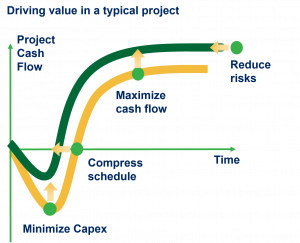
The well tested optimization process with MiniMax begins with the “barebone” design and ends with the highest NPV solution
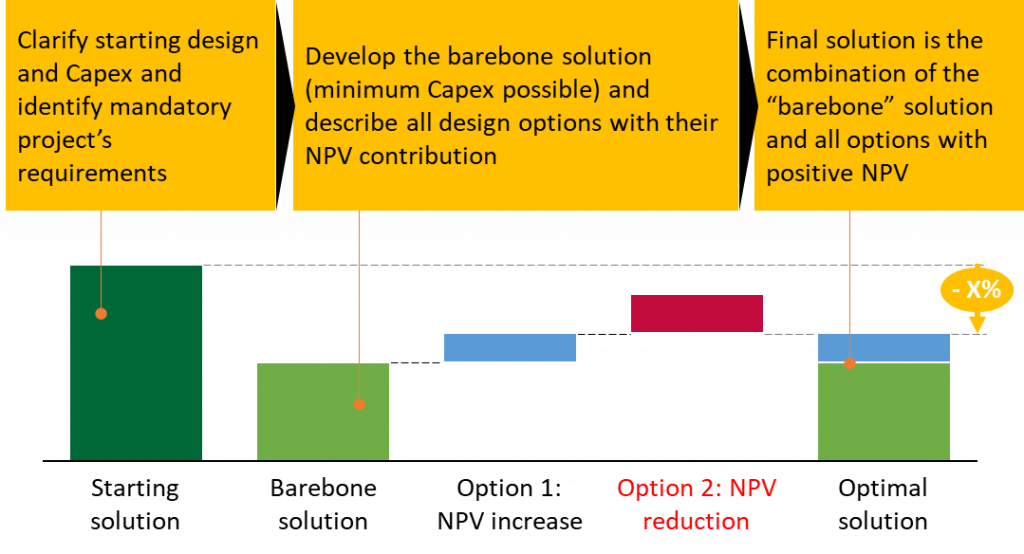
“MiniMax” brings clear benefits
- Higher acceptance: starting position is not the current design where many people worked hardly but the barebone solution that never asked to be developed
- Modular approach: depending on the maturity of the project and scope, the optimization can be done at highest level (Macro) or inside single value creation blocks (Midi)
- Objective decisions: the evaluation of each design option follows a highly standardized process with a proven toolkit
- Quick: normally even the largest projects can be reviewed and optimized within 2 months, this allows to resque projects that were close to be cancelled
I see a new working dynamic between the project team and the management teams, discussing creative and bright ideas with positive outcomes
With MiniMax, we prevent working on an “emotional” scope, but a value based one!
The process and structure bring focus and clarity and with this, I believe, we can execute more projects with less capex in the future