

Managing projects with a stage gate system
The first time I have designed a project steering with stage gates was for complex aircraft turnarounds in military aircraft maintenance. Such an event requires to perform and complete thousands of single tasks (job cards) such inspections, replacements, repairs and tests and involves at least 10 disciplines for 3-6 months. All must be coordinated with aim of closing tasks on time and let the airplane safely fly according to plan.
One could steer these activity with a super complex, multi level and multi disciplines GANTT chart or look for something more pragmatic, but yet effective. This is where a stage gate process shows its value.
Recently, I’ve been facing a similar problem when asked by my client, a well-known Italian multiutility company, to set up the a system to steer projects for realization of public illumination infrastructure. Simpler than the aircraft maintenance example, yet this project presents quite some complexity in coordinating many different disciplines, including public administrators and external companies. The time span of these projects can be all in all of several years with frequent longer waiting times for approval processes.
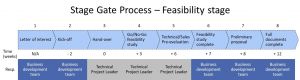
Together with the engineering and realization teams of this client, we have designed, tested and standardized a strong stage gates process. The following steps have driven the design
- Define the end-to-end process from start of the request for quotation until final hand-over of the illumination infrastructure to the municipality
- Define the single stages at the end of we could measure clear-to-define end products e.g., document XY completed
- Estimate the standard duration for each stage. Here is not important to challenge typical duration, but rather to define the most frequent longest duration by which, for sure this stage must be completed. By doing so, we allow a small time buffer before the gate so to ensure the start on time of the next stage.
- At the end of each stage there is a gate in which the project manager should verify the achievement of all criteria to pass the gate. We have defined several “end products” or criteria to be matched in order to move to the next stage. The project team can check before reaching the gate if there is any unmet criteria and accelerate its completion.
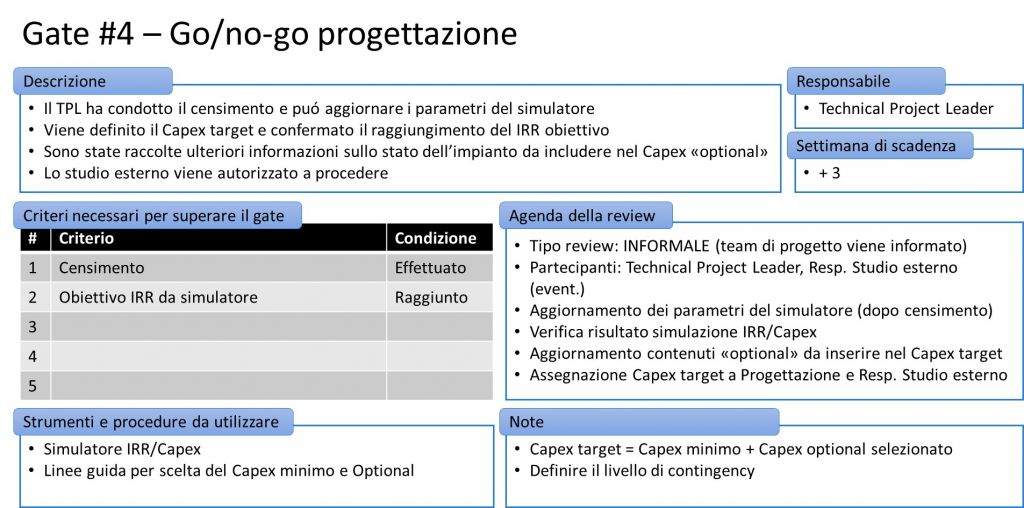
This steering mechanism is pragmatic and effective. Pragmatic because doesn’t force the team to estimate the duration of each and every task, but looks more to the on-time and synchronized delivery of few key end products meeting the gate criteria. Effective because the system doesn’t require to set up a heavy control mechanism with many KPI’s and yet focuses on achieving on-time the single gates which means at the end achieving on-time the final results.